Make Storm Grates Great, Again
Or: How to make the invisible work of municipal employees a source of renewed trust

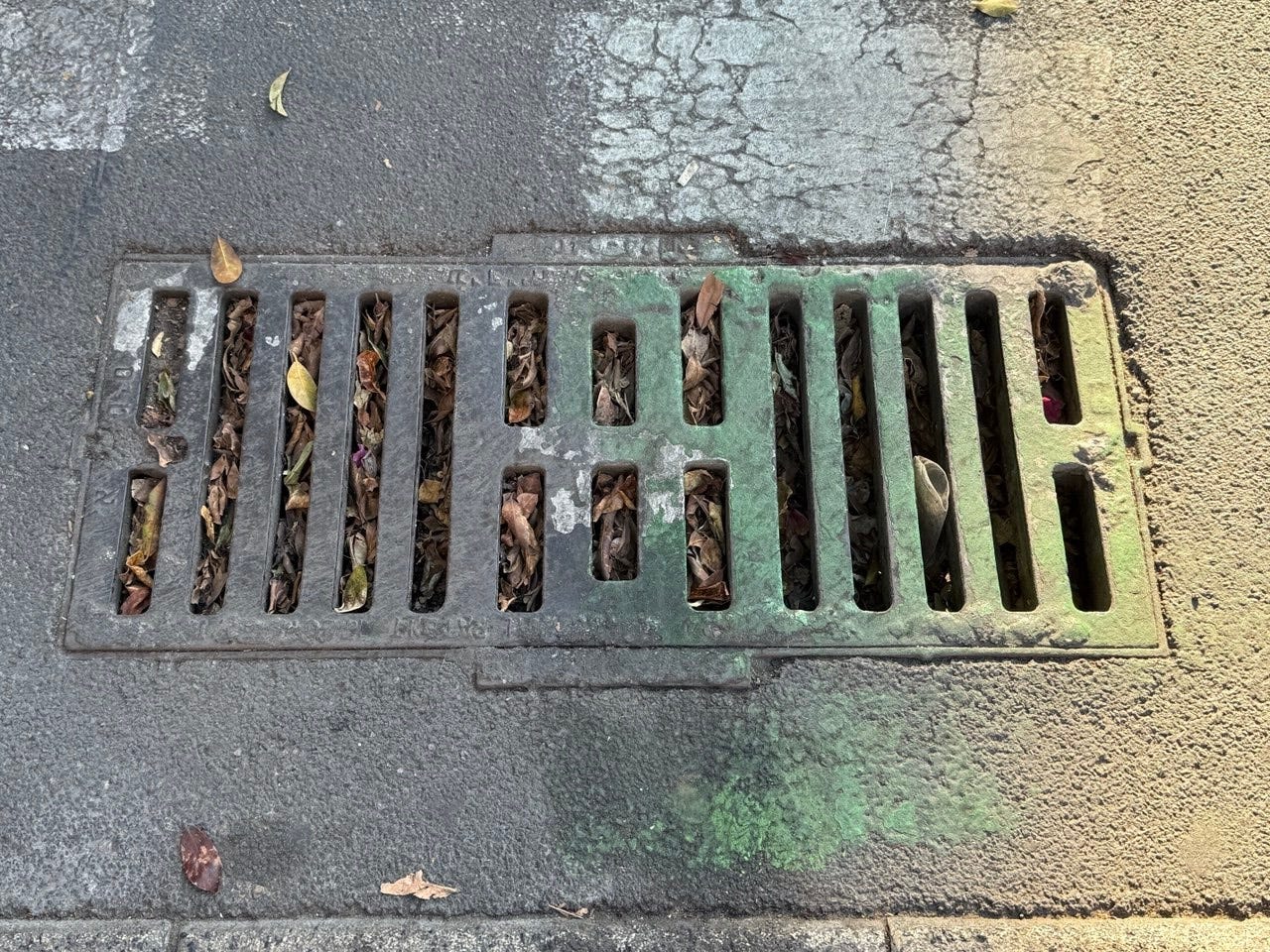
A couple of months ago, I reported this blocked storm grate (or as some call it, storm drain).
Not because I’m particularly passionate about storm grates. But because this one, just next to my house, was completely packed with dead leaves, debris, and whatever else the street had collected over months of neglect. And, as they say in Game of Thrones, winter was coming.
This is the kind of clog that, come the first heavy rain, means flooded sidewalks, pooling water, and the quiet frustration of residents wondering why nobody seems to notice these things and why their taxpayer dollars are not put to work.
So I did what a responsible, civically-minded person does: I reported it to my city.
And then, I waited.
The Eyes on the Street
In her famous book “The Death and Life of Great American Cities” urbanist Jane Jacobs coined the phrase “eyes on the street”, the idea that the safety and health of a neighborhood depends enormously on the casual, unplanned attention of its residents. Ordinary people going about their lives, noticing things.
The same principle applies to municipal maintenance. Local governments simply cannot have eyes everywhere. A public works employee responsible for hundreds of miles of roads, thousands of trash cans, park amenities, streetlights, and sidewalks cannot possibly catch everything. The math doesn’t work.
But residents can, and some choose to help. We walk these streets every day. We notice when the pothole shows up, when the drain fills, when the crosswalk light starts blinking wrong. We are, in aggregate, the most powerful monitoring system a local government has - and oftentimes, we go untapped.
When a local government creates a channel for residents to report issues - a 311 or a “report a concern” phone number, a mobile app, an online form - it’s doing something genuinely important. It’s saying: we know we can’t see everything, and we trust you to help us.
That’s a meaningful gesture. And people respond to it. They take the photos. They file the reports. They expect follow up.
Where Trust Breaks
Here’s what happened after I reported the drain: nothing. No acknowledgment. No update. No automated reply telling me the report was received. No follow-up letting me know it was low priority, or that the crew was behind, or that this particular drain falls under a different jurisdiction. Nothing.
The drain was emptied sometime during winter, but I have no indication that I was the cause.
This is where something quietly breaks. Not the drain of course. What breaks is the implicit promise of the reporting system itself.
When a city asks residents to report problems and then goes dark, it doesn’t just fail to solve the problem. It actively erodes trust. The resident who took the time to stop, photograph, and submit a report learns a lesson: it doesn’t matter. The next time they see something, they keep walking. Eventually, the city loses those eyes on the street entirely; Not because residents stopped caring, but because they stopped believing their care would count for anything.
The cruel irony is that cities often are working. Crews are out. Work orders are being processed. But none of that is visible to the person who filed the report, so from their perspective, nothing happened. The work is invisible. The effort is invisible. And invisible effort earns no credit.
The Operational Transparency Imperative
Here is something worth saying plainly: not every reported issue can be fixed immediately. Sometimes not for weeks. Sometimes not at all.
Budgets are constrained. Priorities compete. A blocked storm drain, however real, may sit below a broken traffic light and a collapsing retaining wall on a crew’s to-do list. That’s not negligence, that’s triage.
Residents, by and large, understand this. They just need a glimpse into the what’s going on behind the scenes, just like they are used to with private sector service (Uber and Domino’s Pizza). The difference between “we received your report and we can’t act on it just yet” and nothing at all is the difference between a resident who feels like a participant in their city and one who feels ignored.
Transparency doesn’t require a fix. It requires honesty. We see this. We can’t get to it this week. Here’s why. Here’s when we might. That’s enough. That’s more than enough, for most people.
Where Threefold comes in
This is precisely the problem Threefold was created to solve.
We connect our resident-facing workflows to the maintenance and asset management software that cities already use: work order systems, the crew scheduling tools and enable field updates, and build a layer of communication on top that residents can actually see and interact with. When you report a blocked drain, you get confirmation. When the work order is created, you hear about it. When the crew closes it out, you know. And when your municipality genuinely can’t get to it for three months, you know that too, and why.
But Threefold isn’t just about notifications. It’s about something bigger: reinforcing trust by allowing residents a glimpse of where their input plugs into the bigger operational picture. we call that operational transparency.
Cities are drowning in administrative friction: service requests that sit in inboxes, work orders that require five steps to create, updates that need to be manually typed and sent. When we automate that layer, something remarkable happens: employees get time back. The 311 or front desk coordinator stops copy-pasting ticket numbers. The public works director stops being the human middleware between a complaint and a crew. The communication that used to fall through the cracks happens automatically, correctly, every time.
What we’re building is a system unlike anything available today to local governments: one that treats residents as partners rather than noise, and treats municipal employees as professionals with expertise rather than bottlenecks to be bypassed. Automation handles the routine. People handle the complex and the irregular. And residents, for the first time, can actually see the difference.
The Grate, Again
The storm drain was long emptied of leaves. But I still don’t know if my report was ever seen. I don’t know if there’s a crew assigned to that block, or what the backlog looks like, or whether this particular drain is someone’s responsibility to clear or no one’s.
That uncertainty is the whole problem. Not the leaves inside the drain, but the uncertainty.
Cities are doing more with less than they ever have. The workers who maintain our streets, our drains, our parks are largely invisible, doing unglamorous work that only gets noticed when something goes wrong. They deserve better than a system that makes their work invisible to the people it serves.
And residents deserve better than silence.
Like in any relationship, trust isn’t built through grand gestures. It’s built in the accumulation of small, reliable ones. We got your report. We’re on it. Here’s where things stand. Over and over, consistently, for every blocked drain and every broken light and every pothole on every block.
That’s what we’re building at Threefold. One storm drain at a time.
Threefold.ai is building the Local Government Operations System that unifies service requests, workflow management and work order management into one flow. Learn more at threefold.ai.